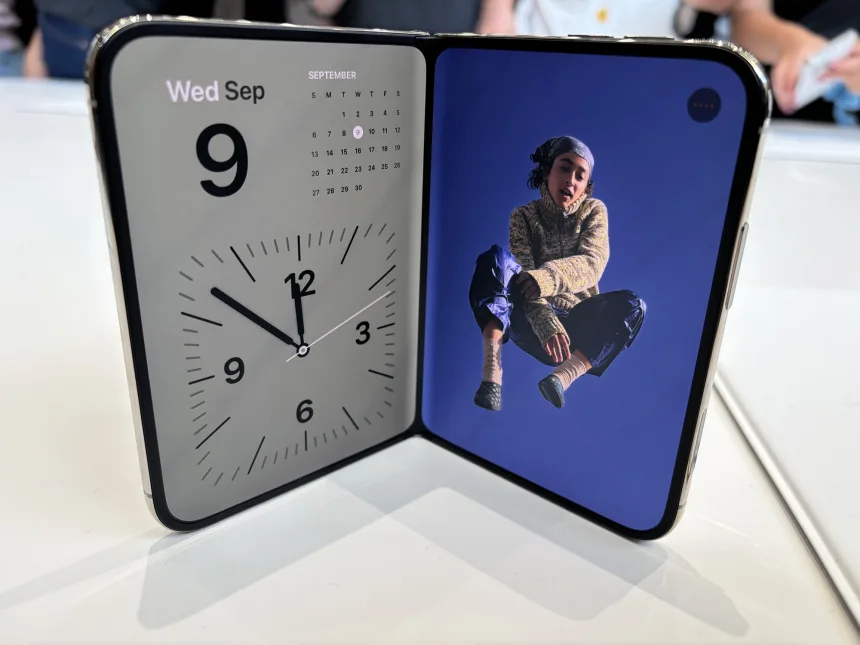
iPhone Duo marks Apple’s most significant redesign of the iPhone in nearly two decades, introducing something the company’s flagship smartphone has never had before: a display that folds in half.
Apple unveiled the iPhone Duo at its event in Cupertino, California, on September 9, positioning the device as a major evolution of its most important product. The company’s first foldable smartphone combines a conventional outer display with a much larger screen hidden inside, creating a device that can function as both a traditional smartphone and a compact tablet.
The iPhone Duo starts at $1,999 and will launch on October 23.
After spending limited hands-on time with the device, the biggest impression is that Apple is not simply trying to make a foldable iPhone. The company is attempting to rethink how the iPhone behaves when its physical shape changes.
A new chapter for the iPhone
The iPhone has evolved considerably since its introduction, gaining larger displays, increasingly sophisticated cameras, faster processors and new software capabilities. However, its fundamental design has remained largely unchanged.
The iPhone Duo breaks from that formula.
The device resembles a passport when folded, with a display on the outside. Opening it reveals a substantially larger internal screen. Apple says it is the thinnest iPhone ever when unfolded, emphasizing how much engineering has gone into fitting a large flexible display into a relatively compact body.
The outer display measures 5.4 inches, while the internal screen measures 7.6 inches. The inner display is roughly comparable in size to an iPad Mini, giving users significantly more screen real estate without requiring them to carry a separate tablet.
The Duo also features cameras on the back, front and inside, allowing Apple to take advantage of the different ways the device can be held and positioned.
A foldable display designed to disappear
One of the most noticeable aspects of the iPhone Duo is its internal display.
Earlier generations of foldable smartphones often drew attention to the physical crease created where the display folds. For some users, the visible line became one of the clearest reminders that they were using a foldable device.
Apple appears to have focused heavily on minimizing that compromise.
The crease on the iPhone Duo is described as barely visible and is difficult to feel when running a finger across the display. The internal screen also has a matte texture designed to reduce reflections and make the surface less prone to visible fingerprints.
That matters because Apple’s challenge is not simply to make a screen that folds. It has to make the folding mechanism feel natural enough that consumers do not constantly notice the technology underneath the experience.
Samsung, Huawei and Motorola have already spent years developing foldable smartphones, and newer Android devices have significantly improved their designs. Apple’s advantage may therefore depend less on being first and more on making the technology feel polished and familiar.
Software designed around the fold
The hardware may be the most obvious change, but Apple’s software could ultimately be more important to the iPhone Duo’s success.
The company has designed the software to respond to the physical position of the device.
When the phone is partially folded, for example, applications can automatically rearrange their content to accommodate the changing screen. Instead of simply shrinking or stretching the interface, the software can move content toward either side of the display.
During hands-on testing, this approach was particularly noticeable when watching video. A Netflix program continued playing as the phone was opened, with the content expanding onto the larger screen without interruption.
Similarly, when the phone was folded slightly into an open-book shape, applications adjusted their layouts so that content could occupy the two sides of the display.
The idea is simple: the software should understand how the hardware is being used rather than forcing users to manually adjust everything.
Multitasking gets more room
The larger inner display also creates opportunities for multitasking.
Apps can operate in split-screen mode, allowing users to work with multiple applications simultaneously. A larger display could make activities such as browsing the web while messaging, reviewing documents while taking notes or watching content while using another application more practical.
Android manufacturers, including Samsung and Google, have already offered similar functionality on their foldable devices.
That means Apple’s challenge is not to introduce the concept but to integrate it into the broader iPhone experience in a way that feels distinctive and intuitive.
FaceTime and photography
The iPhone Duo’s flexible design also changes how its cameras can be used.
During FaceTime calls, users can use both cameras at the same time. The outer display can also act as a preview screen when taking photographs, giving people additional ways to frame shots.
This could be particularly useful when taking photos with the device positioned away from the user.
The foldable design effectively gives the iPhone additional physical positions that a traditional smartphone cannot easily reproduce.
A bedside clock built into the iPhone
One of Apple’s more interesting demonstrations involves a feature that may appear relatively simple: StandBy.
StandBy can transform the display into a bedside clock or photo frame when the phone is locked and positioned appropriately.
Apple already offers StandBy on conventional iPhones, but those devices generally need to be connected to power and positioned on their side.
The iPhone Duo changes that equation.
Because the device can fold and support itself in a tent-like position, it can effectively stand on its own. This makes StandBy more convenient not only beside a bed but potentially on a desk or other surface.
It is an example of the broader idea behind the Duo: the benefit of a foldable phone is not necessarily having a larger screen all the time. It is being able to position the device in ways a conventional phone cannot.
Apple enters a market that already exists
Despite the scale of Apple’s announcement, the company is not entering an unexplored category.
Samsung, Huawei and Motorola have been selling foldable smartphones for years. Yet foldable devices remain a relatively small part of the overall global smartphone market.
Apple’s arrival could change that.
The iPhone remains one of the world’s most recognizable consumer technology products, and Apple has enormous influence over smartphone design and consumer behavior. If the iPhone Duo attracts significant demand, other manufacturers could face greater pressure to develop and promote foldable devices.
At the same time, the Duo’s $1,999 starting price places it firmly in premium territory.
The central question for consumers is therefore whether the ability to fold the phone provides enough additional value to justify spending nearly $2,000.
A crucial product for Apple
The iPhone Duo arrives at an important moment for Apple.
The iPhone is the company’s most profitable product and generates more than half of its revenue. Yet the basic smartphone design has changed relatively little compared with the dramatic transformations Apple introduced in other product categories over the years.
Apple has also faced pressure to deliver another major new product following efforts such as the Apple Vision Pro headset and the iPhone Air, which have not achieved the level of mainstream consumer response the company may have hoped for.
That puts additional importance on the Duo.
Apple is betting that the foldable form factor can give the iPhone a new reason to excite consumers who have become accustomed to yearly upgrades that largely deliver faster processors, improved cameras and incremental design changes.
The role of artificial intelligence
Apple is also positioning the new form factor within its broader push toward artificial intelligence.
At the company’s event, CEO John Ternus described the iPhone as the ultimate personal computer for AI. A larger, flexible display could provide more room for interacting with AI-powered tools, viewing information and performing multiple tasks simultaneously.
The combination of AI and a foldable screen could therefore become an important part of Apple’s longer-term strategy.
Rather than treating the iPhone Duo simply as a phone with a folding display, Apple appears to be presenting it as a new type of personal computing device.
Will consumers pay $1,999?
Ultimately, the success of the iPhone Duo will depend on consumer behavior.
Apple has created a device that appears remarkably thin, offers a large internal display and minimizes some of the visual compromises traditionally associated with foldable phones. Its software is also designed to respond to different folding positions, while features such as StandBy demonstrate how the physical design can enable new use cases.
But none of that guarantees mainstream success.
For many consumers, a conventional iPhone already provides everything they need. The Duo’s larger screen and flexible design will have to offer enough practical value to persuade users that the premium is worthwhile.
Apple’s enormous ecosystem and brand recognition could give foldables a much larger audience, but consumers will ultimately decide whether the category moves beyond early adopters.
The iPhone Duo represents Apple’s biggest change to the iPhone in nearly 20 years. Its success will depend not simply on whether people like a phone that folds, but whether Apple’s hardware and software can demonstrate that folding actually makes the iPhone more useful.
With its October 23 launch approaching, the Duo is set to become one of Apple’s most closely watched products in years—and potentially the device that determines whether foldable smartphones finally become a mainstream part of the mobile industry.